
The Maine Health Data Organization (MHDO) began collecting hospital encounter data in 1990 and health care claims data in 2003. Over the years there have been significant enhancements and improvements in data collection and validation. MHDO continues to work with the data user community to enhance and refine our data sets, while at the same time balancing the administrative burden on those submitting these data.
Due to improvements in the collection of MHDO data and the inclusion of value-add data enhancements, data users may request historical data beginning with 2018 via MHDO’s Data Request Portal. Anyone interested in requesting data prior to 2018 should contact MHDO’s Help Desk for additional information on data availability.
The primary use of MHDO Data as defined in 90-590 Chapter 120, Release of Data to the Public, is to produce meaningful analysis in pursuit of improved health, health equity, and health care quality for Maine people. Acceptable uses of MHDO Data include, but are not limited to, study of health care disparities, health care costs, utilization, and outcomes; benchmarking; quality analysis; longitudinal research; other research; and administrative or planning purposes.
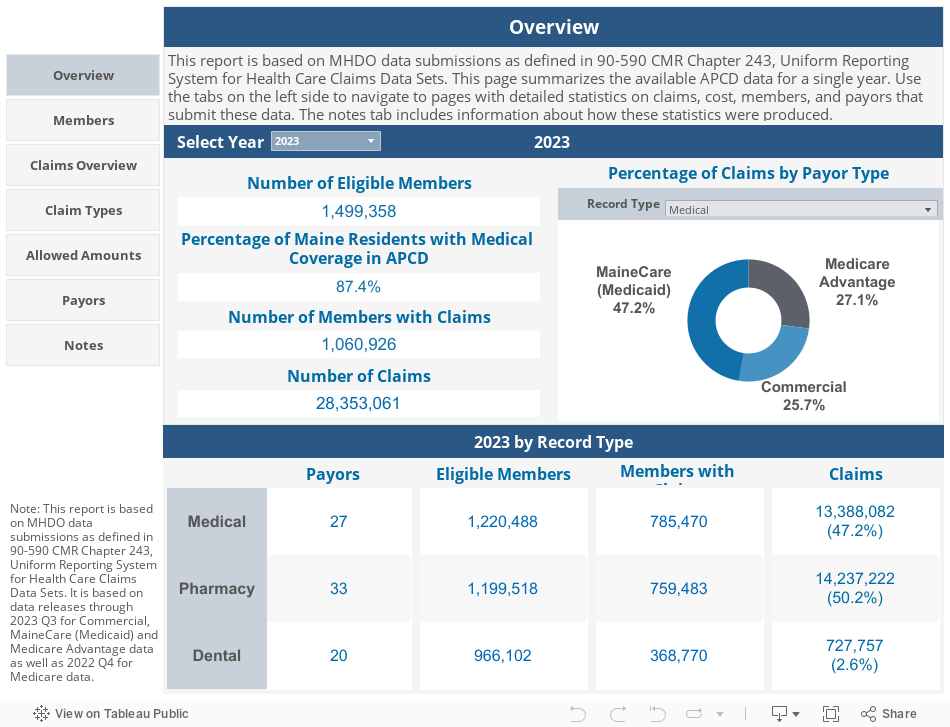
MHDO’s APCD contains millions of administrative health care records consisting of, or derived directly from, member eligibility, and health care claims. The claims data submitted by payors align closely with the information that is populated in the standardized claims forms (UB-04 and the CMS-1500) used by hospitals and other health care providers. Files are submitted by health care claims processors (payors) pursuant to MHDO rule 90-950 Chapter 243, Uniform Reporting System for Health Care Claims Data Sets. MHDO receives Medicare claims data for the state of Maine from the Centers for Medicare & Medicaid Services (CMS) and integrates these claims into the MHDO’s APCD. Due to the timing in Medicare claim processing and the CMS request process, Medicare claims are available for release on a different schedule to that of their Commercial and MaineCare counterparts, by roughly 6-9 months (see MHDO Release Schedule, for details). MHDO’s APCD is the most comprehensive statewide claims data available.
The claims reported to the MHDO include all MaineCare and Medicare (both Original Medicare and Medicare Advantage) members, approximately 84% of the fully insured individual and employer-sponsored plans, and approximately 26% of the self-funded employer-sponsored plans (referred to as Commercial).
A portion of the self-funded employer-sponsored plans are Employee Retirement Income Security Act of 1974 (ERISA) plans, and they are exempt from submitting data to state APCDs due to a United States Supreme Court decision released in March 2016 in Gobeille v. Liberty Mutual Insurance Company. However, some of the largest self-funded ERISA plans submit data to MHDO on a voluntary basis. Health plans with less than $2,000,000 in annual premiums are exempt from submitting data to MHDO. MHDO’s claims data does not include data for the uninsured or workers compensation. A full list of exclusions can befound in 90-590 Chapter 243, Section 2 A 9(a-d).
Federal Rule, 42 CFR Part 2, also known as the Confidentiality of Substance Use Disorder Patient Records, is a federal regulation that protects the privacy of individuals (and their records) seeking substance use disorder (SUD) treatment from certain types of federally assisted programs, known as Part 2 programs. This federal regulation allows for the submission and release of de-identified SUD data as defined by HIPAA’s de-identification standard. Beginning with January 2025 data, de-identified SUD data is included in MHDO’s data releases. Fields that are left blank for SUD records in released data are intentionally blank. De-identification strikes a balance between the need to protect sensitive SUD information and the need to use and share that data for research, public health initiatives, and improving outcomes.
Reports from MHDO and other data users are available for review as samples of possible analysis.
Check out the MHDO Release Schedule for information on recent and upcoming data releases.
The MHDO APCD includes files with member eligibility, medical claims, pharmacy claims, and dental claims information. The MHDO Data Dictionary defines and describes the data elements available for release in MHDO’s Level 1, 2 and 3, APCD and other integrated and supplemental data. The information available in the data dictionary includes the field names, data types, descriptions, and standard code sources.
The interactive dashboard below provides more details about the MHDO APCD data that are available for request via the MHDO Data Request Portal.
Data applicants can select up to a 6-month runout of the claims data. This means that MDHO will send any claims that have a paid date in the authorized request timeframe (i.e. Q1 2022 – Q2 2023) but were not submitted to MHDO until after that quarter was already released to users. Any additional claims will be sent at the time of the next quarterly release (i.e. Q1 or Q2 2023 runout claims available for release with the Q3 or Q4 2023 data).
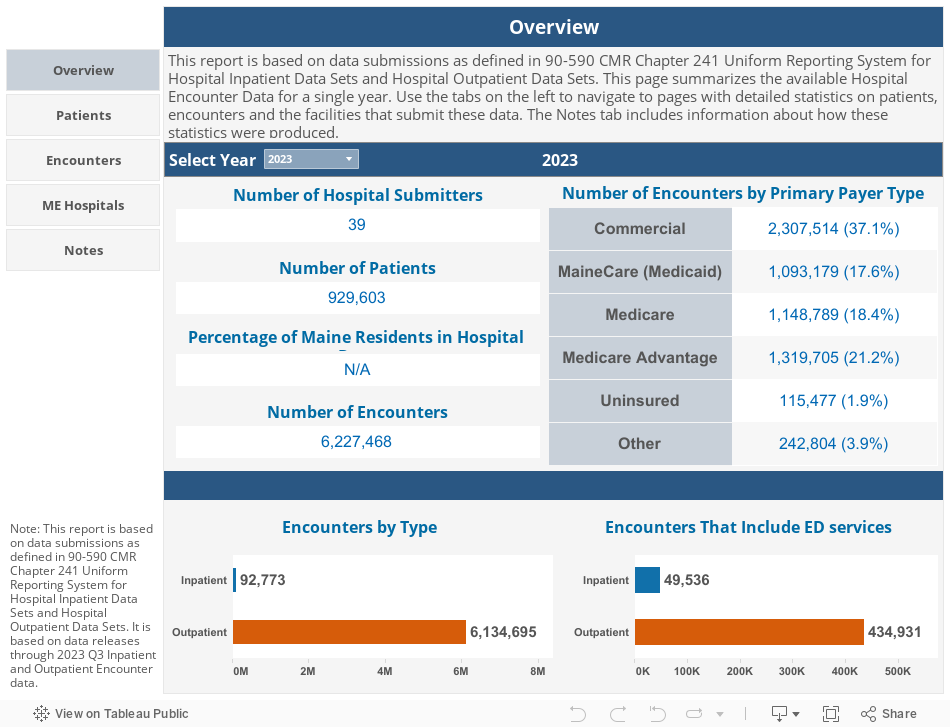
Maine hospitals submit data as defined in MHDO Rule 90-590 Chapter 241, Uniform Reporting System for Hospital Inpatient Data Sets and Hospital Outpatient Data Sets, including data from inpatient and outpatient hospital settings, and their provider-based clinics/practices. The hospital encounter data submitted by hospitals align closely with the information that is populated in the standardized claims forms (UB-04 and the CMS-1500) used by hospitals and other health care providers. For example, the data includes diagnosis and treatment information, as well as length of stay, and provider identifiers. The files submitted include all hospital encounters with individuals regardless of their insurance coverage status (i.e. includes uninsured and self-pay patients). The releasable data set does not include payment information. Refer to the MHDO Data Release Schedule for the most current data available.
The MHDO Hospital Encounter data includes hospital inpatient and outpatient (including provider-based clinics) information. Emergency Department (ED) data is included in both inpatient and outpatient datasets. Note: If data users are interested in ED data they should request both the inpatient and outpatient data sets to ensure all ED encounters are captured. The MHDO Data Dictionary defines and describes the data elements available in the hospital inpatient and outpatient encounter data, as well as other integrated and supplemental data. The information available in the data dictionaries includes the field name, data types, descriptions, and sources for codes.
The interactive dashboard below provides more details about the MHDO Hospital Encounter data that are available for request via the MHDO Data Request Portal.
MHDO collects hospital financial data from Maine’s hospitals as described in 90-590 Rule Chapter 300, Uniform Reporting System for Hospital Financial Data. The financial information reported to MHDO is posted on MHDO's Standardized Hospital Financial Reports page. The standardized financial reports are based on the hospital's unconsolidated audited financial statements; specifically, the balance sheet, statement of operations and changes in net assets. Beginning with FY 2021, MHDO is collecting and posting standardized financial reports for the health systems in Maine based on their consolidated audited financial statements.
MHDO collects Health Care Quality data, including Nursing Sensitive Patient Centered (NSPC) data and Healthcare Associated Infection (HAI) data, per the requirements defined in 90-590 Chapter 270, Uniform Reporting System for Health Care Quality Data Sets. Note: Data from Maine’s three psychiatric hospitals (Riverview Psychiatric Center, Dorothea Dix Psychiatric Center, and Northern Light Acadia Hospital) are exempt from submitting health care quality data to MHDO.
The HAI quality measures collected by MHDO include central line catheter-associated blood stream infections (CLABSI), catheter-associated urinary tract infections (CAUTI), surgical site infections for knee and hip arthroplasty, methicillin-resistant staphylococcus aureus (MRSA) and clostridium difficile (C. diff) lab events, as well as data on urinary tract infections (UTI) and antimicrobial use and resistance (AUR). MHDO NSPC data includes information on hospital pressure ulcers and falls with or without injury.
MHDO also publicly posts annual Hospital Quality Data Reports on our website and on CompareMaine.
NCBP data are submitted by payors to the MHDO as prescribed in 90-590 Chapter 247, Uniform Reporting System for Non-Claims-Based Payments and Other Supplemental Health Care Data Sets. These files include aggregate payments that are for something other than a fee-for-service claims. These payments include but are not limited to:
The NCBP data that MHDO is authorized to release to authorized data users as described in 90-590 Chapter 120, Release of Data to the Public, includes the following aggregated data elements:
Contact MHDO for questions regarding NCBP data requests.
As defined in 90-590 and 10-144, Chapter 730, Interagency Reporting of Cancer-Incidence Registry and Vital Statistics Data, the Maine Cancer-Incidence Registry data is integrated into the MHDO APCD and Hospital Encounter datasets. The integrated Cancer Registry files include registrant demographics, diagnostic information, and treatment dates when available. Note: The files are updated annually and are on different release schedules than the APCD and Hospital Encounter data. See MHDO Data Release Schedule for details.
As defined in 90-590 and 10-144, Chapter 730, Interagency Reporting of Cancer-Incidence Registry and Vital Statistics Data, the Vital Birth and Death Statistics data are integrated into the MHDO APCD and Hospital Encounter datasets. The integrated vital statistics files primarily include pertinent demographic information. Note: The files are updated annually and are on a different release schedule to the APCD and Hospital Encounter data. See MHDO Data Release Schedule for details.
The MHDO De-Identified Person Directory file provides a single, anonymized MHDO de-identified Person ID as a common identifier to allow authorized data users to track a de-identified individual across MHDO’s data sets. The directory also includes a set of attributes (date of birth, sex, race, and ethnicity) determined to be the most common valid value across all submitted records in MHDO’s datasets. Note: Data applicants seeking APCD race and ethnicity data should include the MHDO De-Identified Person Directory in their request.
The Practitioner Identifiable Data can be selected as a value-add in a data request under Special Data Elements and includes additional information on individuals and organizations providing the healthcare service in both the claims and hospital encounter datasets. This information includes National Provider Identifiers (NPI), along with specific practitioner and organization names. There are five different types of providers identified in the MHDO data depending on the data stream (APCD or Hospital Encounter Data), as shown in the table below.
| Provider Type | Definition | MHDO Data Stream(s) |
|---|---|---|
| Attending | The individual who has the overall responsibility for the patient’s medical care and treatment reported in the claim. | APCD Hospital Encounter |
| Billing | Provider submitting the bill. |
APCD Hospital Encounter |
| Operating | The individual with the primary responsibility for performing the surgical procedure(s). |
APCD Hospital Encounter |
| Referring | The individual who directed the patient for care to the provider rendering the services being reported. | APCD |
| Rendering | The person or company (laboratory or other facility) who rendered the care. | APCD |
The race and ethnicity data can be selected as a value-add in a data request under Special Data Elements and includes Race and Ethnicity information at the hospital record level in the Hospital Encounter Data. Note: Race and ethnicity data are also available as part of the MHDO De-Identified Person Directory, which includes a single composite set of race and ethnicity fields for a De-Identified Person ID. Data applicants seeking APCD race and ethnicity data should include the MHDO De-Identified Person Directory in their request.
The Payor Name/ID can be selected as a value-add in a data request under Special Data Elements and includes the commercial insurer’s name and ID as submitted to MHDO. This does not include the name of the specific health plan. Note: By default, the Payor Category field (Medicare, Medicaid, Commercial) is included in all APCD datasets.
The Anonymous Payor Name/ID can be selected as a value-add in data request under Special Data Elements and includes an MHDO assigned numerical ID for commercial insurers. This ID code allows the user to differentiate records between commercial payors without identifying the actual name of each payer. Note: By default, the Payor Category field (Medicare, Medicaid, Commercial) is included in all APCD datasets.
The Group Name/ID can be selected as a value-add in a data request under Special Data Elements and includes insured employer group/policy numbers. This allows the authorized data user to potentially identify records associated with a single policy type or employer group. Note: The release of this data element requires additional conditions to be met prior to data request application submission, as outlined in 90-590 Chapter 120, Release of Data to the Public, Section 3, §3D 1-4.
The data request process can be found on the MHDO Data Request page. To create an MHDO Data Request Portal Account, click here.
Please see our FAQs if you have additional questions.